The component has worn out. A shaft that was once perfectly dimensioned is now running loose. A journal surface that should be smooth is scored with abrasion marks. This is the moment most production managers dread: buy a new component at a far higher cost with weeks of lead time, or attempt a repair with conventional methods that carry no guarantee.
There is a third option. And at Laser Indonesia, it's what we do every day.
Laser Cladding & Laser Metal Deposition (LMD): Restore Your Components, Don't Replace Them
The component has worn out. A shaft that was once perfectly dimensioned is now running loose. A journal surface that should be smooth is scored with abrasion marks. This is the moment most production managers dread: buy a new component at a far higher cost with weeks of lead time, or attempt a repair with conventional methods that carry no guarantee.
There is a third option. And at Laser Indonesia, it's what we do every day.
What Is Laser Cladding?
Laser Cladding — also known as Laser Metal Deposition (LMD) or Directed Energy Deposition (DED) — is a precision metal coating process using a laser beam. A specialised metal powder is injected directly into the laser's focal point, melting together with the substrate surface and fusing into a true metallurgical bond.
The result is not a coating that sits on top of the surface. It is a genuine metallic bond — as strong as the base material itself, and in many cases harder and more resistant to corrosion and abrasion than the original component.
We Understand the Problem You're Facing
We have spoken directly with engineers across many sectors: power generation, oil and gas, manufacturing, heavy industry. The concerns are almost always the same.
A worn component cannot wait. Every hour of downtime is real, measurable production loss. Providers capable of this work in Indonesia are extremely limited. Sending components overseas for repair means costs and lead times that simply don't make business sense. And conventional methods — thermal spray, hard chrome, standard welding — often fail to deliver sufficient bond strength, or introduce distortion into heat-sensitive components.
This is precisely why we developed laser cladding capability starting in 2021. Since then, we have restored dozens of turbines, rotors, shafts, journals, blades, nozzles, pump housings, drilling heads, and rotary components across industries throughout Indonesia.
Why Laser Cladding Outperforms Conventional Methods
If you have used hard chrome plating, HVOF thermal spray, or conventional welding to restore worn components, you already know their limitations. Excessive heat distorts dimensions. Coatings that don't bond fully. Hidden porosity that only reveals itself once the component is back in service.
Laser cladding works in a fundamentally different way. Heat input to the component is minimal and precisely controlled — the laser melts only the zone being coated, in milliseconds, while the rest of the component remains cool. The result is extremely low dilution: a single layer is sufficient to achieve near 100% coating material purity at the surface, without altering the metallurgical properties of the substrate beneath.
Distortion? Minimal. Heat Affected Zone? Tightly controlled. Porosity? Nearly eliminated, because the process runs under inert gas shielding — argon or nitrogen — throughout.
Our Team: People Who Understand Materials, Not Just Machines
The best laser cladding equipment in the world produces nothing useful in the wrong hands. This process requires deep knowledge of metallurgy, the behaviour of each cladding material, the thermal characteristics of different substrates, and how to programme a robot to move with sub-millimetre precision across complex three-dimensional surfaces.
Our laser cladding team has built this knowledge through hundreds of hours of real-world work — not in a laboratory, but in the field: at client workshops, at power plants from Banten to Banyuwangi, in facilities that cannot afford extended downtime.
Before every job, we go through a technical assessment with you: what is the base material? What dimensions need to be restored? Which cladding material best suits the component's operating conditions? We do not begin until we are confident in the parameters.
Our Equipment
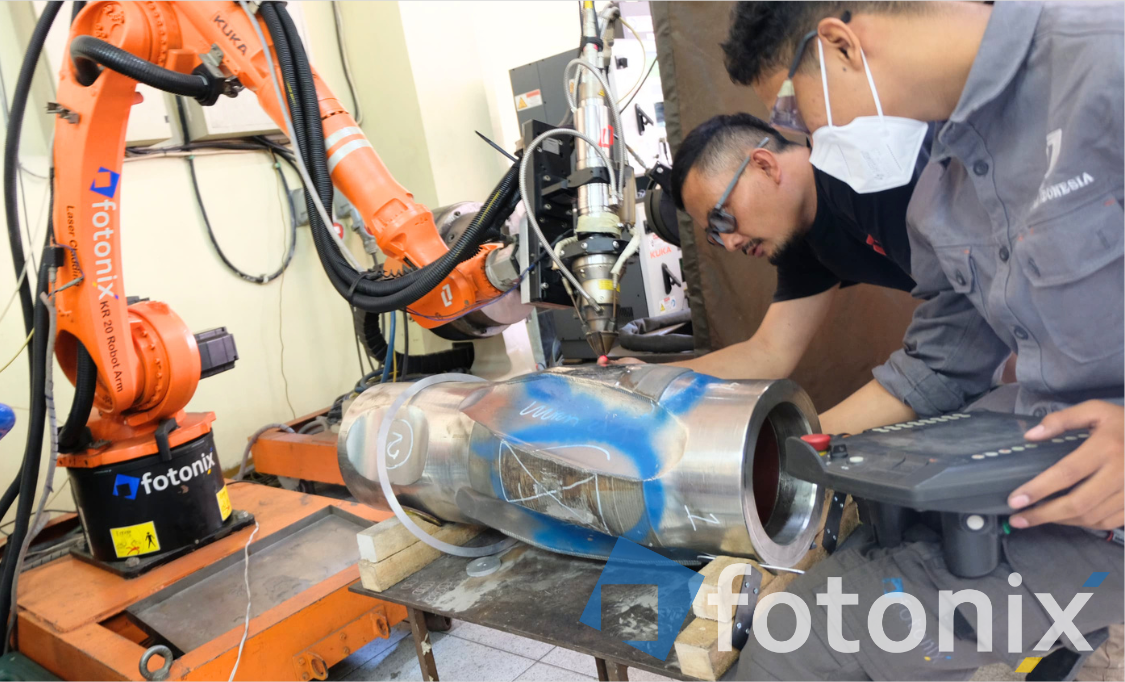
Our laser cladding system is built on components selected for one reason above all others: proven reliability under real industrial working conditions.
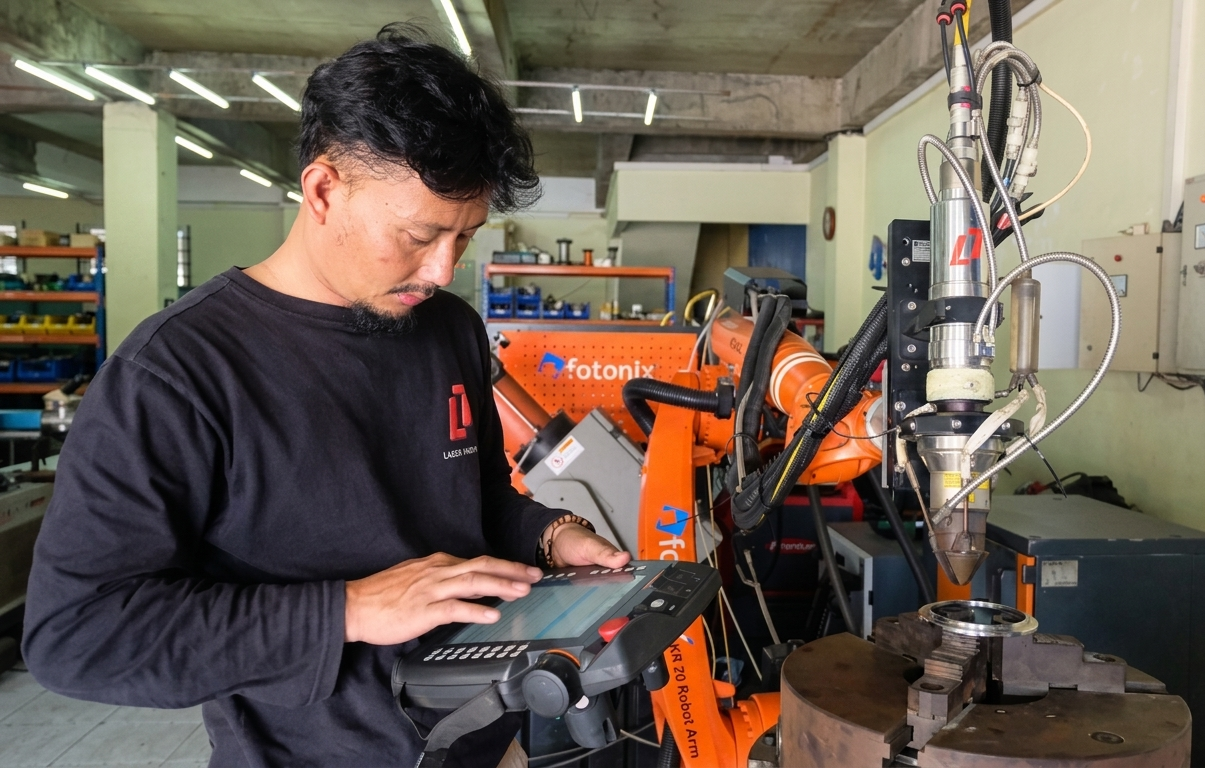
Laser source: Coherent HighLight DL4000HPS
A 4,000-watt fiber-delivered diode laser. This technology was developed in Germany by the engineering team now part of Coherent Inc. — one of the most trusted names in industrial laser systems worldwide. What distinguishes this unit from other industrial lasers is its all-in-one design with an integrated chiller that requires no deionized water and no external cooling infrastructure. The system can operate at any location — a power plant in Kalimantan, a factory in Banyuwangi, an offshore platform — as long as there is adequate electrical supply.
Cladding head: Coherent PH50DL
This European-developed optic head is purpose-built for additive manufacturing and cladding processes. Its beam shaping homogenizer produces a top-hat intensity profile — unlike the Gaussian profile common in other lasers, the top-hat distributes energy evenly across the entire coating area, producing more consistent cladding and lower dilution. The 3-jet coaxial nozzle delivers metal powder symmetrically from three directions to the laser focal point, ensuring precise and uniform deposition regardless of robot travel direction. The system also includes VIR (Vision with IR illumination) for real-time process monitoring.
Motion system: KUKA 6-axis robot + 2-axis positioner
Eight total degrees of freedom allow the cladding head to reach angles and positions that systems with fewer axes simply cannot access. This is critical for components with complex geometry — turbine blades, stepped surfaces, features recessed inside machine housings. The repeatability of a KUKA robot at this class is ±0.05mm — well within the tolerances required by the cladding process.
All three components — laser source, cladding head, and robot — are integrated into a single coherent working system by the team at Fotonix, our subsidiary and the only KUKA Official System Partner for robotic laser processes in Indonesia.
Available Cladding Materials
- Stellite 6 — high abrasion and corrosion resistance at elevated temperatures (max 3mm thickness)
- Stellite 12 — harder than Stellite 6, for extreme wear applications
- Inconel 625 — outstanding corrosion resistance, ideal for aggressive and offshore environments
- Inconel 718 — high strength at elevated temperatures, for turbine components
- Tungsten Carbide NiCrSiN CTC 40/60 — maximum hardness, for heavy abrasive applications
- Rockit 401 (FeCrNiMo) — HRC 50-54 hardness, cost-effective alternative to Stellite
- 316, 410, 420, 431 Stainless Steel — dimensional restoration with compatible materials
- Aluminium — for aluminium alloy components
Applications We Have Worked On
Power Generation: steam turbine blades and nozzles, generator shafts and journals, rotor discs, high-pressure valve components
Oil & Gas: drilling heads, pump housings, sleeves, valve seats, downhole components worn by sand and drilling fluid contact
Manufacturing & Heavy Industry: mill rolls, screw conveyors, crushers, cam shafts, bearing journals, rotary components from internationally branded heavy equipment
Marine & Offshore: propeller shafts, rudder pins, components requiring seawater corrosion resistance
We Come to Your Location
Large components cannot always be moved. A turbine installed inside its housing cannot simply be disassembled and shipped to our workshop in Bandung. We understand that.
Our laser cladding system was designed from the ground up for mobility. The complete unit can be loaded onto a truck and operated anywhere with road access and an adequate power supply. Our team is experienced working in diverse field conditions — confined spaces, elevated positions, remote locations, under tight schedules.
We have completed laser cladding projects across Java, Sumatra, Kalimantan, and Sulawesi. If you have components that need restoring at your facility, contact us and we can assess feasibility together.
Important Note: Technical Consultation Comes First
Laser cladding is a highly specific process. Not every component suits every cladding material, and not every wear condition can be addressed in the same way. Before we work on your component, we need to understand: the base material, operating conditions, the cause of wear, and the performance target after restoration.
This initial technical consultation is provided at no charge. We would rather decline work that isn't a good fit than take on a job that won't deliver the result you need.
We also want to be clear: we are specialists in the laser cladding process, not specialists in every type of equipment our clients operate. For highly specific components, we recommend consulting the equipment manufacturer or a relevant domain expert before the process begins. This transparency is part of how we maintain long-term client trust.
Start the Conversation Today
Tell us about the component you're dealing with. Photos of the wear condition, the dimensions that need restoring, the base material, and the operating environment — that is enough for us to assess feasibility and give you a realistic cost indication.
Our technical team will respond within one business day.
Contact us:
WhatsApp / Phone: +62811-952-737
Email: info@laserindonesia.com
Workshop: Jl. H. Amir Machmud No. 539, Cimahi — Monday to Saturday, 08:00–17:30 WIB
Empowering Indonesia through laser technology.